

Travel Story · Chile
Rapa Nui (Easter Island) with Kids
How our family ended up at the most remote spot on Earth, and made it feel easy with a four- and six-year-old.
This trip was kind of random, and I mean that in the best way. I hadn’t really heard of Rapa Nui before we booked it. I barely knew what it was or where it was.
October is birthday season in our house. All four of us have birthdays within a month of each other, so we always take a birthday trip, and the kids had a full week off for October break. I told my husband I wanted to keep it easy. Somewhere in South America. Houston to Buenos Aires is a direct flight. I was not trying to make this complicated. And then my husband said, “What about Easter Island?” And I said, what? I genuinely did not know what that was.
Turns out it’s halfway to Tahiti, the most remote inhabited island on the planet, and it would take us three separate flights to get there. A sane person might have said absolutely not. But there’s a reason we married each other, and I wasn’t about to be the one to say no. So with just over a month to go, we booked it.
Teaching the Kids First
This wasn’t a trip we wanted to surprise the kids with. We wanted them to understand it before we ever got on the plane. So we got books about Easter Island and read about the fascinating history of how the island was discovered and the mysterious way these enormous statues were created and moved around the island. We made our own moai statues out of modeling clay. By the time we landed, they knew what those giant stone faces were, why they mattered, and were thrilled to finally see how big they were in real life.
Here’s the other reason I’m writing all of this down. When I went looking for information about visiting Rapa Nui with young kids, there was almost nothing out there. Plenty about the island, not much about doing it with a four- and six-year-old in tow. So consider this the resource I wish I’d had.

Getting There
Our route was Houston to Bogotá, Bogotá to Santiago, and finally Santiago to Rapa Nui. Three flights, each about five hours. I know that sounds brutal. It honestly wasn’t. We left Houston at 2 PM and we arrived in Easter Island at 3 PM the next day. We used points to fly business class for the second and third leg, so we arrived rested and ready to explore.
And here’s a pleasant surprise, especially with kids: Rapa Nui sits almost exactly on Houston’s clock. When we went in October, the island was on the same time as home, so there was no jet lag, no wrecked sleep schedules, none of the days-of-cranky-kids that usually comes with flying this far. We landed and everyone was on their normal time.
One small heads-up if you travel at a different time of year: both Houston and Rapa Nui observe daylight saving time, but on opposite schedules, since they’re in opposite hemispheres. So depending on your exact dates, the island is either the same time as Houston or just an hour behind, never more than that. Either way the jet lag is basically nonexistent, which is a small miracle for a place this remote. If a big time change has been the thing keeping you from a trip like this, let this be your sign.
One money-saving tip: book the Santiago to Rapa Nui flight on the Chilean LATAM site. It’s noticeably cheaper than the United States version for the exact same seat. LATAM is the only airline that flies to Rapa Nui, and there are only 1 to 2 flights per day depending on the season.


Landing on the Island
When you land on Rapa Nui, it immediately feels like a remote island. The Nayara team was right there waiting for us at the airport to welcome us with flower heis. It felt islandy from the very first minute. They walked us out, drove us the short way to the resort, welcomed us with drinks, checked us in, and we wasted no time sitting down to plan our stay.


Where We Stayed
There are basically two luxury hotels on the island. We stayed at Nayara Hangaroa, which sits closer to town, so you can walk into the village from it, though in hindsight we never really needed anything in town except to do a little souvenir shopping. The other option is Explora Rapa Nui, a bit outside of town, which I’d still love to experience someday. I’ve only heard incredible things.
Here’s a fun fact that actually matters for planning: there’s no cell service anywhere on the island outside of that one town, Hanga Roa. Once you leave it, nothing. The drivers and guides all communicate by radio. Inside the resort you’ve got Wi-Fi and cell reception, but out at the sites you’re completely off the grid, which ends up being kind of wonderful.


The Best Part: They Planned Everything
One of the best things about staying at Nayara Hangaroa is this: they planned and handled every one of our excursions. All of it.
This matters more than it might sound. Many of the sites on the island require a licensed guide. Even if you rent a car, you still can’t visit a lot of them without one. So we skipped the rental entirely and used the hotel’s transportation, guides, and expertise for everything. Prior to our arrival they had sent us information about excursions, so we had an idea of what we wanted to do, however once we arrived they were able to walk us through what was realistic with our kids, our length of stay, all while keeping the weather conditions in mind.
The drivers would take us out in vans with just a handful of other resort guests, which kept every outing small and intimate. We ended up becoming friendly with the other guests because we kept landing on the same excursions together. There is something so magical about watching our kids make friends with children from all over the world despite language barriers.
I plan travel for a living, and I don’t hand over the reins easily; however I happily handed them over here. Four nights turned out to be the perfect amount of time to see the whole island without ever feeling rushed.
Our Itinerary, Day by Day
Here’s exactly how our days played out, in case it helps you map your own.
Day One
After checking in and settling into our room, we had dinner outside at Vaikoa, which had incredible views of the ocean, cocktails, pizza, and fruit plate with a tiny chocolate moai. Afterwards we walked from the hotel to Ahu Tahai (Ahu means ceremonial stone platform) for sunset. A taxi would have been quicker, but we wanted to experience the town. We did actually bring the stroller to Ahu Tahai, but that was the only time we used the stroller. There’s a big grassy field there where the kids could run around, and the moai stand right against the sky as the sun drops. We got some of our favorite photos of the whole trip here.


Day Two
The big day. We were up before dawn for sunrise at Ahu Tongariki, the largest and most famous platform of fifteen restored moai, at 6:30 AM. The guide brought chairs and blankets, and we watched the sky light up behind the statues while our guide told us their history. We learned the ceremonial platforms or “ahu” were burial grounds for important chiefs or ancestors. A moai or statue was carved and placed above the ahu to honor them. This is one of those experiences that doesn’t leave you and it’s most definitely worth the early wakeup.
Unfortunately, right after the sun rose it started down pouring so we ran back to the van, but we were able to come back the following day to get up close. We headed back to the resort for breakfast at Poerava, which has a fantastic breakfast buffet with local and international options.


At 9:30 AM we headed out again to Ahu Akivi, the rare moai that face the ocean instead of inland, then Puna Pau, the little crater quarry where the red topknots were carved, and Ahu Vaihu, the site of eight toppled moai, and hare paenga, the traditional boat-shaped homes where our kids got a glimpse of what life on the island looked like centuries ago.


Afterwards we headed back to Nayara Hangaroa, where we had lunch at Poerava and the kids refueled with some chicken nuggets and fries.
At 3:00 PM we went up to the stunning Rano Kau volcano, which is one of three main extinct volcanoes on the island. This overlooks the ceremonial village of Orongo, where we learned about the Birdman competition.
Every year, each Rapa Nui clan sponsored an elite athlete called a hopu to compete in the Birdman competition. The hopu climbed down the cliffs of Rano Kau, swam to Motu Nui, waited for the first sooty tern egg of the season, and then raced back carrying it without breaking it. The chief who sponsored the winning hopu was named the Tangata Manu (Birdman) and gained religious, political, and social leadership over the island for the following year.
We finished the day at Ahu Vinapu, which is famous for having the finest stone masonry on Easter Island—so precise that it has been compared to the famous Inca walls of Peru.


After a busy day, we returned to Nayara where we had a lovely upscale dinner at Kaloa and we enjoyed some Chilean wine.


Day Three
For our 9:30 AM excursion we visited Ahu Nau Nau, the moai that sit right on Anakena beach. These are some of the most well preserved moai because when they toppled centuries ago, many became buried in sand which protected them from erosion. According to Rapa Nui tradition, this is where the island’s first king, Hotu Matu’a, landed when he arrived and settled the island.


We also visited Pitokura which is home to the largest moai ever erected, although now it lies face down. There is also a famous round stone here called “The Navel of the World” that supposedly has magnetic powers, according to Rapa Nui tradition.


At 3:00 we went to Rano Raraku, the quarry where every moai on the island was carved, its hillside still dotted with half-finished statues. We had to hike up a bit here, but nothing the kids couldn’t handle. There was a lot of hand holding, but it was absolutely worth it. Every moai was carved here and mysteriously transported to its ceremonial platform. A single moai can weigh 86 tons! It is widely thought that they were “walked” to their final location.


After we came back down, we revisited Ahu Tongariki where we admired the stunning fifteen moai that were beautifully restored. Then the kids hit the pool before dinner.


Day Four
A slower day. We walked into Hanga Roa town and did some souvenir shopping. Walking through this tiny town (the ONLY town), it’s hard to imagine living somewhere so isolated. In a world where we have so many options for everything, walking through Hanga Roa really makes you stop and think about what is really necessary to have.


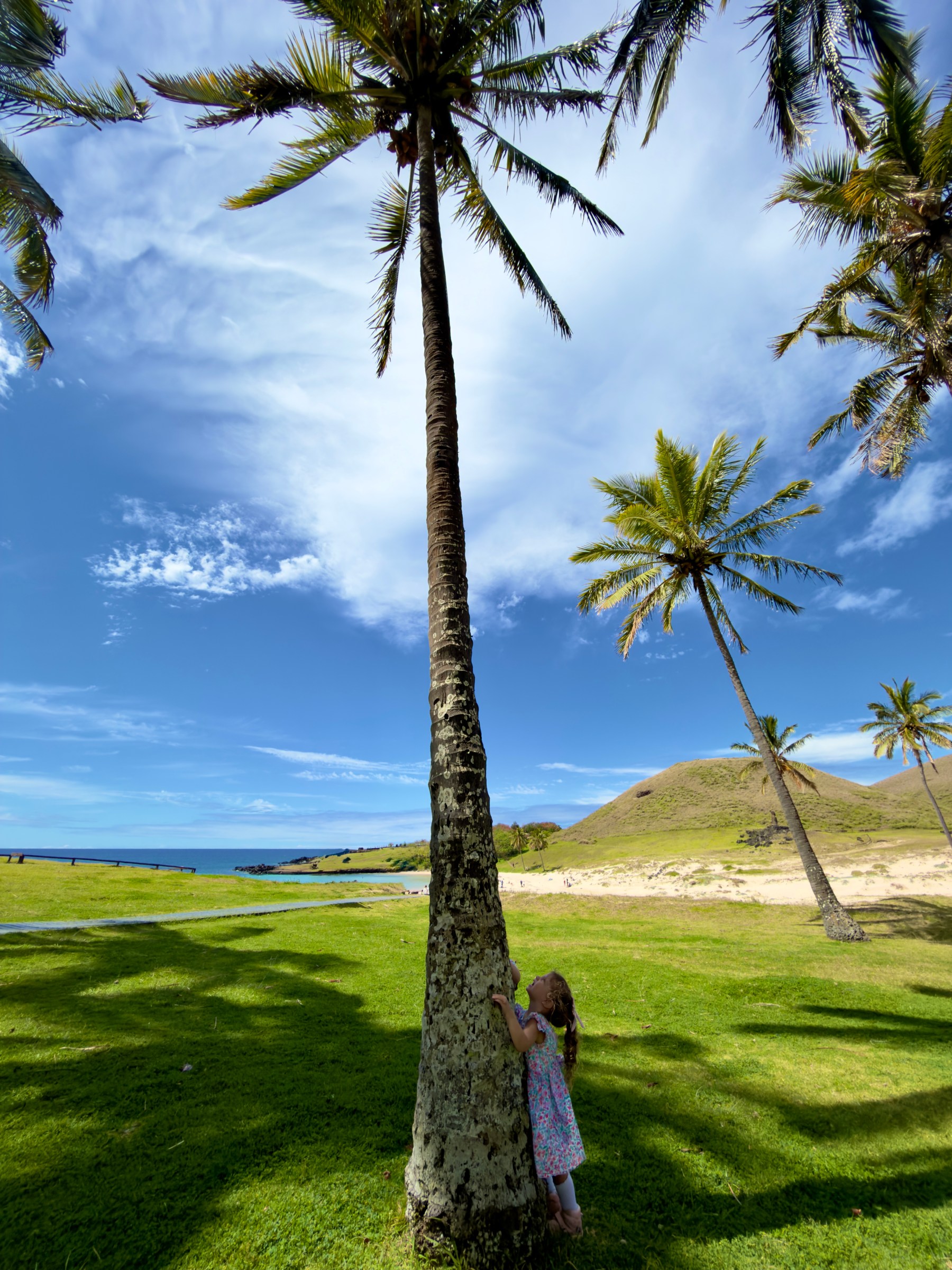
Afterwards, we took a taxi out to Anakena for a proper beach day. This is the only beach in Rapa Nui with white sand, since most of the coast is rugged rock and it might be one of the most gorgeous beaches I’ve sat on. The water was chilly, so the kids just put their feet in and spent the rest of the time playing in the sand. There are souvenir stands, a restaurant, and bathrooms there as well.


That evening we had an early dinner at Vaikoa and then we went to a traditional dance show, where the kids got their faces painted and were completely mesmerized by the performance. The Haka’Ara Tupuna Cultural Group performs several styles of dance including ancestral Rapa Nui dances, warrior dances, and Polynesian dances. Our son was even brave enough to get up on stage with the dancers!


Day Five
Our departure day. On the way out, after breakfast, we were sent off with bead necklaces, which means we will come back one day. We got the kids Rapa Nui bracelets, which unfortunately our daughter realized she lost right after we made it through security at the airport. By some miracle, at the most remote airport in the world, they had another of the exact same bracelet in the gift shop. Phew.


For being the most remote airport in the world, it was actually the most kid-friendly airport we’ve been to. Much of the waiting area is outside in a little grassy area where the kids could terrorize the chickens and play with sticks.


To make the most of our time in South America, we flew back to Santiago, Chile where we stayed for three nights, followed by Buenos Aires, Argentina for three nights before we flew back directly to Houston.

Doing Rapa Nui with Little Kids
Did we ever see a playground? Nope. But I would argue the wildlife was more entertaining. The island is full of free roaming horses, dogs, chickens, and cows. Our vans were constantly stopping to let horses and cows cross the road. The kids were completely delighted every single time. They were outside exploring a new environment where they were welcomed for the curious kids that they are, and fortunately Nayara Hangaroa had familiar kid-approved foods for them like chicken nuggets and French fries.
Funny story. I’m a minimalist packer, and I did not let the kids bring stuffed animals. So my resourceful daughter grabbed her yeti socks from her suitcase and somehow those socks became the trip mascots. Each kid carried one around on their hand the entire time, like little sock puppets, because they didn’t have a stuffy. The most remote island on Earth, and our emotional support animals were a pair of socks.

Would I bring little kids here again? Yes, with one honest caveat. The terrain is rocky and uneven, often dirt and mud with loose little rocks that get slippery. It would be genuinely hard with a wobbly toddler who isn’t steady on their feet yet. If you’ve got a baby you’re happy to wear, and you like hiking with a baby, that could actually be lovely. The majority of the places we went I would not say were stroller friendly. Our kids were four and six, and they did great and we were able to see the entire island. If your kids still nap, it might make going on two excursions a day a bit difficult. There were a few longer hikes we might have done without kids, but honestly, we didn’t feel like we missed much.
What to Pack
A few things I’d tell anyone going. Hiking shoes with real traction are non-negotiable, given all that dirt, mud, and loose rock. We got these and these for the kids. Bring layers and a light rain jacket. We went in October, which is spring there, and had pretty good weather. It rained a couple of times but never derailed a single plan.
Before you go: You’ll need to buy the Rapa Nui National Park ticket online in advance. It’s required to visit any site outside of Hanga Roa town, and you’ll show it at basically every moai site. There’s also a Rapa Nui entry form to fill out before you arrive. Sort both of these before you fly so you’re not scrambling.
Worth Every Mile
Rapa Nui with kids was so much more than I expected when my husband first threw out the idea. It’s one of the farthest places you can physically go, and yet it ended up being one of our smoothest, most magical family trips. No jet lag, nothing to plan once we arrived, just our family standing together at the literal edge of the world, watched over by these giant stone faces that have been there for centuries.
If it’s been sitting on your bucket list, don’t wait until the kids are older. Take them now. Teach them the stories, hand them a sock puppet if that’s what it takes, and let somewhere this remote feel this easy.
Where to Stay on Rapa Nui
Nayara Hangaroa
This is where we stayed, and I can’t recommend it enough for a family. The team welcomed us at the airport with flower heis, planned and handled every one of our excursions so we never had to figure out a thing, and made a trip to one of the most remote places on Earth feel genuinely effortless. Eco-luxury built right into the island’s landscape, with a staff that treated our kids like their own.
- Upgrade on arrival, subject to availability
- Breakfast for two
- $100 hotel credit
- Early check-in and late check-out, subject to availability
- Premium bottle of wine welcome amenity
Explora Rapa Nui
The island’s other luxury stay, set on a bluff just outside Hanga Roa with all-inclusive guided explorations built in. We didn’t stay here this trip, but it’s high on our list and I’ve only heard incredible things. If you’d like to weigh both for your dates, I can book either one for you.
- Upgrade on arrival, subject to availability
- Breakfast for two
- $100 hotel credit
- Early check-in and late check-out, subject to availability
Hotel-only bookings are complimentary. As a Fora advisor, I’m paid by the hotels, not by you.
This post may contain affiliate links. If you book or buy through them, I may earn a small commission at no extra cost to you. I only ever share the places and things we’ve actually used and loved.
Leave a Reply